A poll asks one quick question to get a count. A survey asks several questions to find out what people think and why.
So if you only need to know which option wins, run a poll. If the answer will cost money or change how people work, run a survey.
First: the “polls” you see in the news are really surveys. Pew Research Center puts it this way: “the term ‘poll’ is usually applied to a survey designed to measure people’s opinions.” An election poll has many questions and a carefully chosen sample. This post uses the everyday meaning: the one-question vote you’d run in a chat, a meeting or on a website.
Polls vs. surveys at a glance
| Poll | Survey | |
|---|---|---|
| What you get | A count | Reasons, patterns and comparisons |
| Questions | Usually one | Several, in a planned order |
| Answer types | Pick one, or yes/no | Rating scales, multiple choice, open text |
| Time to answer | Seconds | Seconds to minutes, depending on length |
| Who answers | Whoever sees it | People you chose to ask |
| Anonymity | Often no names, by habit | A choice you make and state up front |
| Analysis | Read the percentages | Compare groups, track trends, read comments |
| Where it lives | Chat, social post, slide, web page | Email, link, QR code, inside a product |
Length sets the time. In our own data from the three years to July 2026, a survey of 1–5 questions took a median of 28 seconds. At 11–15 questions it took about 3 minutes 15 seconds.
How to choose: three questions
Ask these in order. One “survey” answer is enough.
1. What happens if the answer is wrong?
If the team picks the second-best date for the offsite, nothing bad happens. Poll. If you change your pricing because of a bad read, you pay for it for months. Survey.
2. Will your next question be “why”?
Say 60% of your team votes to keep Friday stand-ups. Keep them. Now say 60% of your customers vote against a new feature. You’ll want to know who they are and what they dislike. A poll can’t tell you, so start with a survey.
3. Do you need to compare groups?
A poll gives you one number for everyone. If you need to see new customers against long-time ones, or one department against another, you need a few more questions and a plan for who you ask.
Two quick examples:
- “Which Thursday works for the workshop?” Poll.
- “Should we move to a four-day week?” Survey, even though it sounds like a yes/no question.
When a poll quietly becomes a survey
It usually starts with “just one more question.” Then someone adds a third. A week later you have six questions in a poll tool and a chart going into a board deck. Here’s what breaks.
The numbers stop being about your whole audience. A poll reaches whoever happened to be there. A poll on your website hears from people who visited that week and cared enough to click. “78% of customers want this” really means “78% of the people who clicked.” With a survey, you decide who to ask first, and that’s what lets you speak for a group. If you do need to speak for a larger group, read up on sample size and margin of error.
You lose the reason. A count shows that people prefer option B. It can’t show whether they love B or just dislike A. One open-text question fixes that, and it’s the first thing a poll leaves out.
You can’t connect the answers. Four separate polls give you four separate charts. A survey ties each person’s answers together, so you can see whether the people who gave you a low score are also the ones who left a complaint.
The fix is simple: when you catch a poll growing, rebuild it as a short survey. Short doesn’t cost you much. In the same three years of data, 99.4% of people who started a survey of 1–5 questions finished it.
Questionnaire vs. survey
A questionnaire is the list of questions. A survey is the whole project: choosing who to ask, asking them and making sense of the answers.
Every survey has a questionnaire. A poll is the smallest version of both. People swap the two words freely, and nobody gets hurt. The difference only matters if you’re writing up a research method.
Can you run a poll in SurveyRock?
Yes, as a one-question survey. There’s no separate poll type, so you don’t have to pick a different tool as your question grows.
- Add one Multiple Choice or Yes or No question.
- Publish it.
- Share the web link, or add a QR code under Distribute.
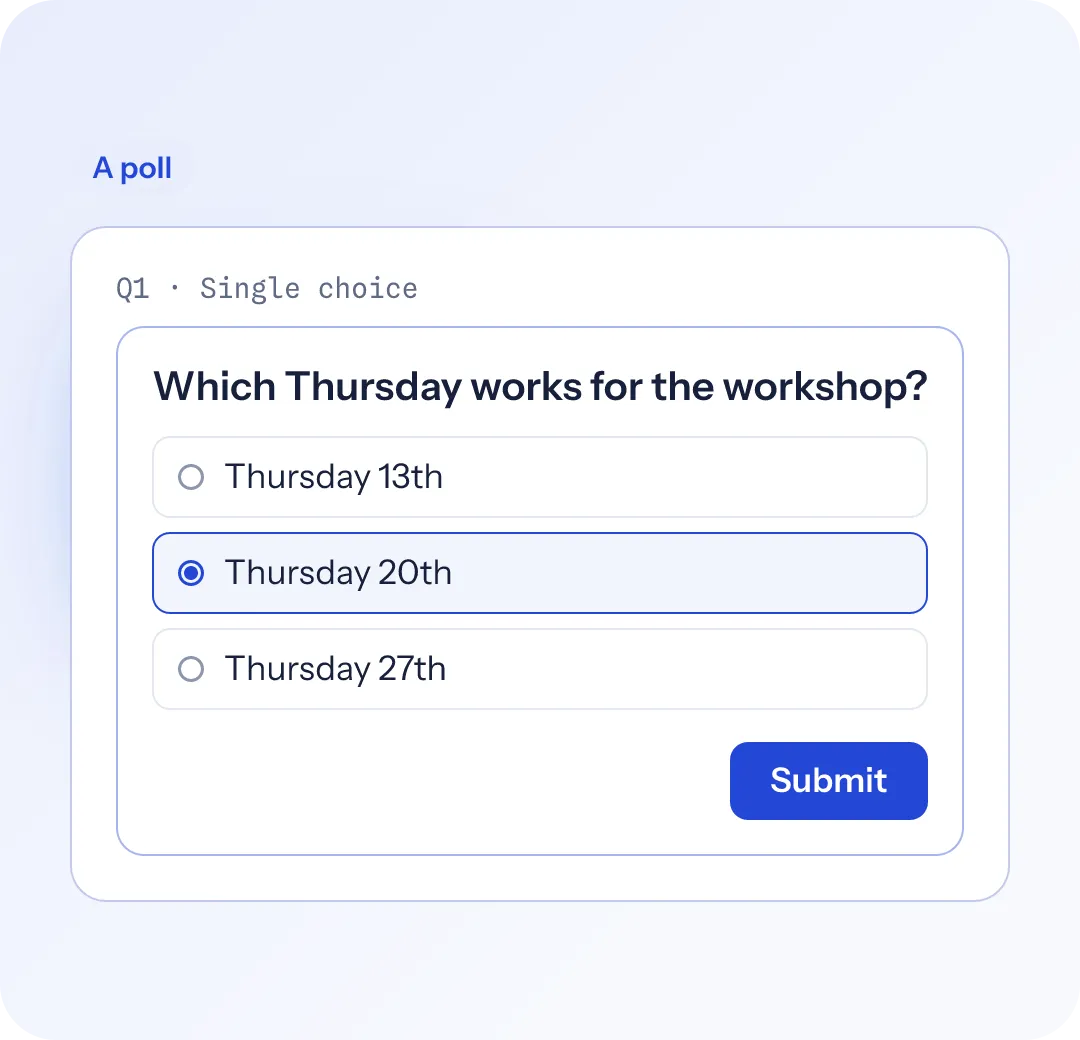
Set the link to One response per person if you want one vote each. The limit is per link, so stick to one. It uses a browser cookie, so treat it as a deterrent, not a guarantee: someone who switches browsers can vote again. For a stricter vote, send unique links by email, which starts on the Solo plan.
Want it anonymous? Switch on anonymous collection before you share the link. It covers answers from then on, and you can’t turn it off once responses are in. It’s on every plan.
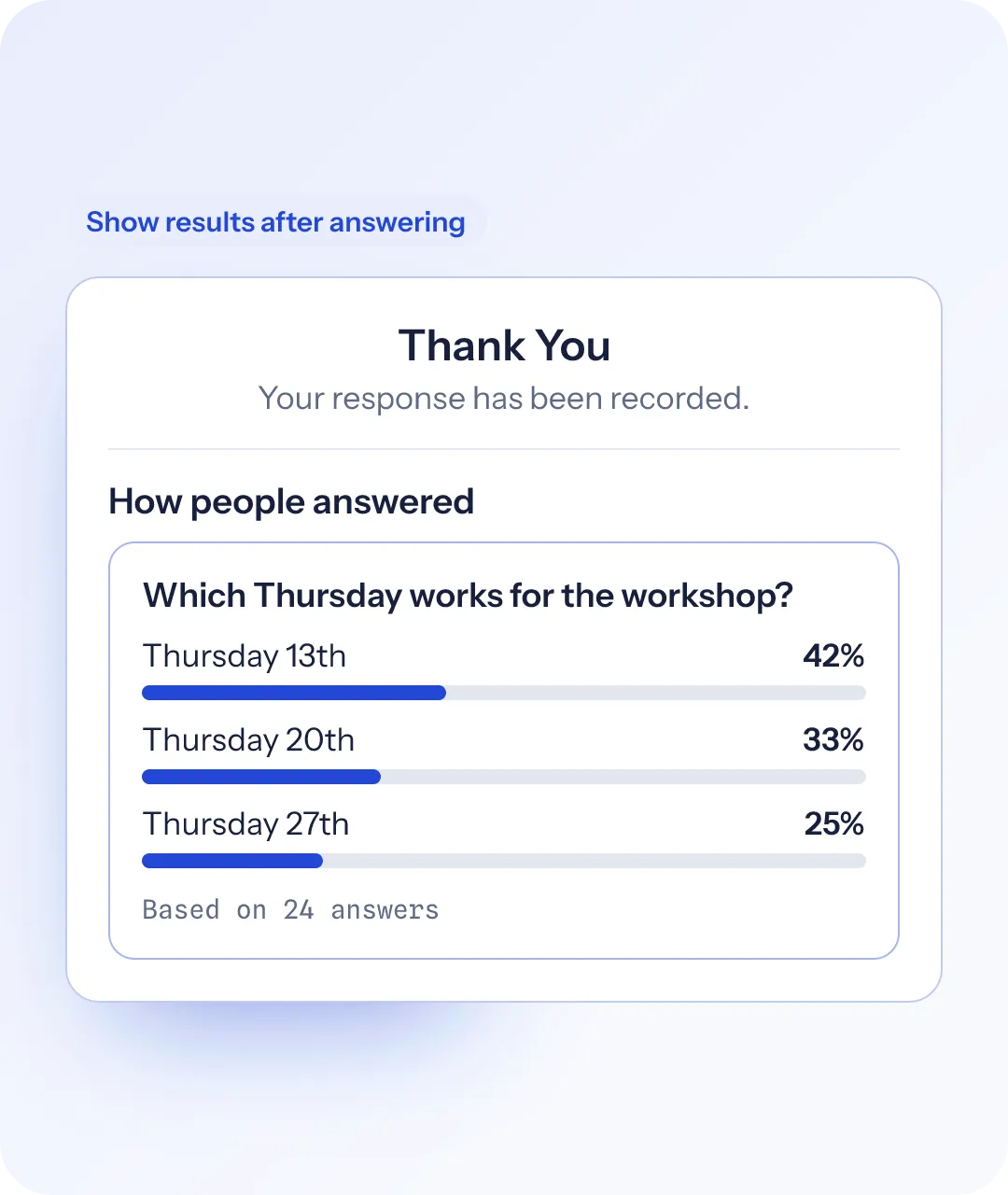
In a chat poll, everyone sees the tally as votes come in. Here, on Team and above, turn on Show results after answering for the link, and people who finish see charts of how everyone has answered so far, right under the thank-you message. On Free and Solo they see the thank-you message only. Either way, you see the full results in your dashboard, and on Team and above you can filter them to compare groups and share a report link.
FAQ
Is a poll a type of survey?
Yes. A poll is a very short survey, usually one question. Survey researchers use the word for any survey that measures opinion, however long it is.
How many questions can a poll have?
Most polls have one. Past two or three, you’ve got a short survey, so treat it like one: think about who you’re asking and how you’ll read the results.
Which is more accurate, a poll or a survey?
Neither is automatically more accurate. Accuracy comes from who answered and how many of them. A casual poll hears from whoever turned up, so it’s weak for speaking about a whole group. A survey sent to a planned sample is stronger.
Are polls anonymous?
Not automatically. It depends on the tool and how you set it up. If people need to know their answer can’t be tied to them, check the setting and tell them what it does.
Build either one free in SurveyRock. Start a free account. The Free plan covers 3 surveys of up to 10 questions and 100 responses a month.